Vehicle Loan Education
Auto Loan Audit: What It Covers and How It Works
A plain-English guide to reviewing a vehicle contract, from the contract terms and payment record to add-on products, fees and the lender that holds the account.
Most people sign a vehicle financing agreement at the end of a long day at the dealership, after the price, the trade-in and the monthly payment have already been negotiated. The paperwork that follows is dense, and small errors in it are easy to miss. Over a five- or six-year term, those errors can add up to real money.
An auto loan audit is an independent, document-by-document review of that paperwork. At Strategic Defense Audit we read the retail installment sales contract, the buyer’s order, the payment history and the account statements, then check whether the numbers agree with each other and with the disclosures you were given. You receive a written summary of what the records show, with each finding tied to the page it came from.
What a Review of Auto Loans Covers
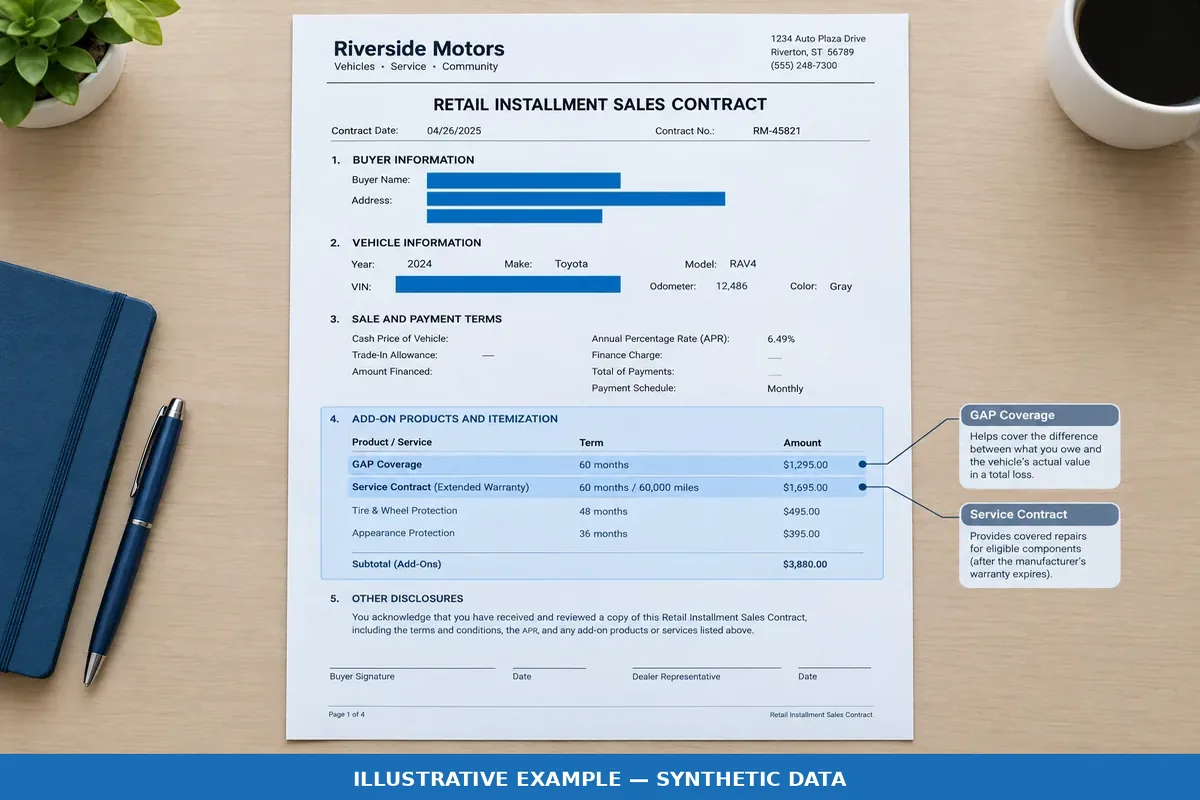
Every file is different, but the same core questions come up in almost every vehicle finance review:
- Does the amount financed on the contract match the cash price, taxes, fees and trade-in figures on the buyer’s order?
- Is the annual percentage rate disclosed correctly, and does the finance charge match the rate and term?
- Were add-on products such as GAP coverage, service contracts or credit insurance disclosed as optional, and are their prices consistent across documents?
- Has each payment been applied to interest and principal correctly, and does the current balance reconcile with the payment history?
- Were late fees, extension fees or repossession charges assessed according to the contract terms?
- Which lender or finance company holds the account today, and is there a documented record of how the contract was assigned after signing?
Most dealers do not hold the financing themselves. The contract is usually sold to a bank, a captive lender or another lender within days, and the dealer may receive a markup on the interest rate for arranging it. That is allowed in most states, but it is one reason the rate you were quoted and the rate on paper sometimes differ.
Borrower Reviews vs. Dealer Inventory Checks
The phrase gets used for two unrelated kinds of work, and search results mix them together.
The first is the borrower-side review described on this page: a check of one person’s vehicle debt and the records behind it.
The second is a dealer floorplan review. Dealerships buy the cars on their lots with a revolving line of credit called floorplan financing. The floorplan lender sends auditors to the lot, often unannounced, to count the vehicles and confirm that every unit that left the lot has been paid off on time. These lot checks let the lender confirm the dealership is utilizing financing appropriately. Many dealers also run a dealer self-audit or a self-managed dealer audit before the lender arrives, to catch “sold out of trust” units and paperwork gaps.
Strategic Defense Audit does not perform floorplan or inventory audits for dealerships. We work only for individual borrowers. If you found this page while looking for help with a floorplan check, a dealer accounting firm or your floorplan lender is the right place to start.
Common Findings
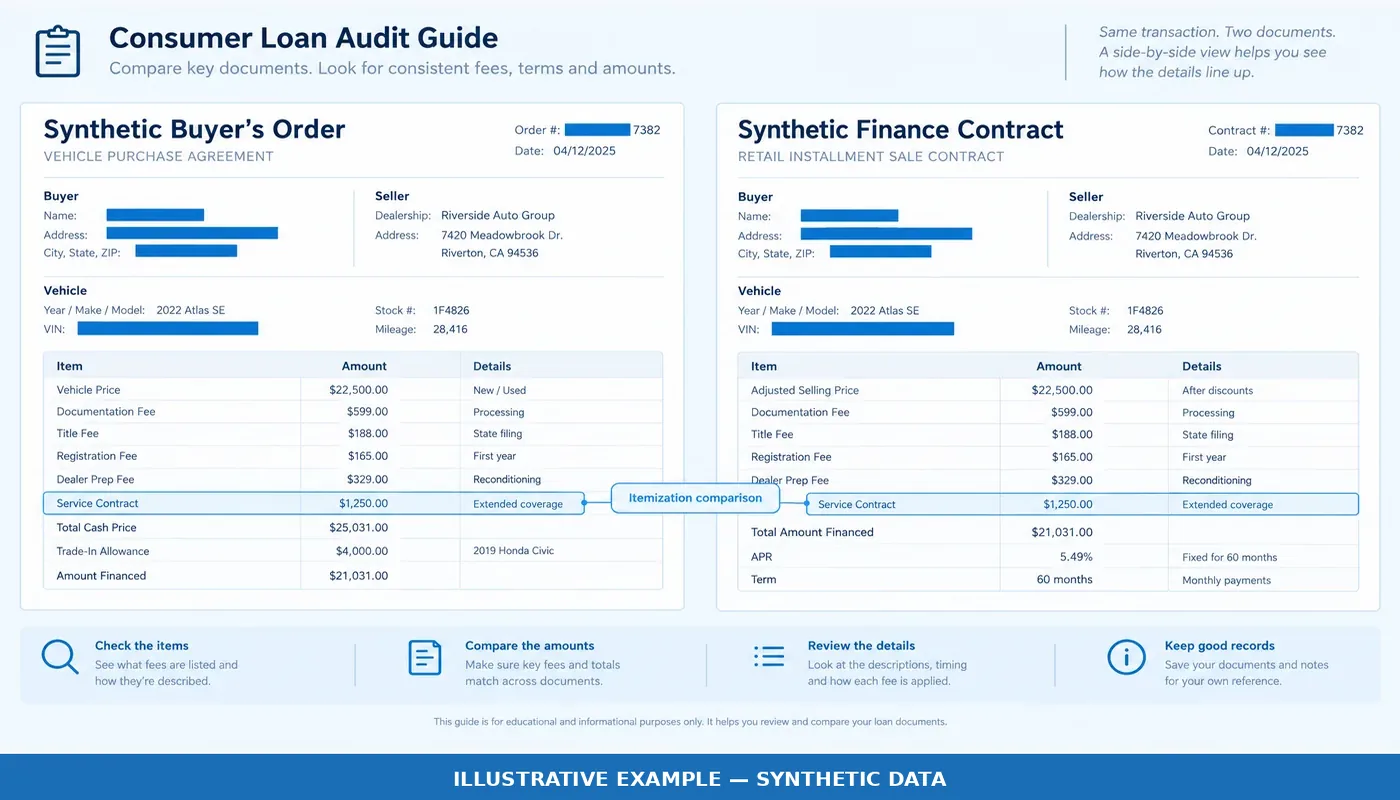
Whether any of these appear in your file depends entirely on your documents. In our experience, the issues that come up most often are:
Figures that do not carry over. A price, fee or trade-in value on the buyer’s order that changes on the installment contract without explanation. This is the most common discrepancy we see, and often the easiest to document.
Add-on products the buyer did not expect. Service contracts, theft-deterrent packages, GAP coverage or credit insurance that appear on the contract with little explanation. The FTC’s guide to financing a car is clear that add-ons are optional and should appear only at the prices you agreed to, and the CFPB’s auto loan resources explain what to look for.
Payment application errors. Payments posted late, applied to fees before interest, or not reflected in the balance. These are usually visible only when the payment history is rebuilt line by line.
Rate differences. An APR on the contract that is higher than the rate discussed, or a total interest cost that does not match the stated rate and term.
Gaps in the ownership record. Where the contract was assigned to a new lender, the assignment and the title record should show it. When a collector or repossession agent cannot show who holds the debt, that is worth documenting.
How the Process Works
1. Free consultation. You speak with Daniel Guillemot, our client representative and your point of contact throughout. You tell him what you are facing, and he tells you honestly whether a review is likely to help. We talk with each client personally, seven days a week, 9am to 6pm Pacific.
2. Document collection. You send the contract, the buyer’s order, statements and any letters from the lender. If you are missing documents, we explain how to request them. Our document checklist lists what to gather.
3. Reconciliation. We rebuild the numbers: amount financed, finance charge, APR, payment schedule and current balance, and compare each against the disclosures.
4. Written findings. You receive a clear summary of what the records show, what is missing, and which source each finding came from. It is written so you, a financial advisor or an attorney can verify every point.
When you are ready to request a loan audit, the pricing page lists each package, turnaround time and what it includes.
Why Auto Financing Errors Happen
Auto financing moves fast. A single deal can involve the salesperson, the F&I manager, an application sent to several lenders at once, and a contract that is assigned to one of them before the buyer gets home. Each handoff is a chance for a figure to change. The financing agreement is the document that controls, so that is where a review starts.
Common sources of error include a trade-in payoff entered incorrectly, a rebate applied to the price on one form but not the other, an add-on product priced differently on the buyer’s order and the contract, and a spot delivery where the financing was re-written after the buyer had already taken the car. The FTC calls this last practice yo-yo financing, and the terms in the second contract are usually worse.
Errors also appear after the sale. Auto loans are frequently transferred between servicers, and each transfer creates a new account record. Payments can be misapplied in the changeover, late fees can be assessed during a period when the new servicer had not yet posted payments, and the payoff figure can drift from the amortization schedule. Rebuilding the account is the only reliable way to see whether that has happened, and it is part of the process for every file we review.
None of this means something went wrong in your case. Many auto debt files reconcile cleanly. The point of a proper review is to know rather than guess, and to have the financial picture in writing if you need to raise a question with the lender that holds the contract.
Who Tends to Benefit
A vehicle loan review is most useful when something in the account does not add up. Borrowers usually contact us when they question the loan balance, notice a fee they cannot explain, want to verify the terms before refinancing, are disputing a repossession or deficiency balance, or simply want an independent second opinion before they sign something new.
Auto loans are one of the largest categories of household debt in the country, and auto lenders process millions of contracts every year. Most are correct. An independent review is how you find out whether yours is one of them, and a clean result is a financial answer in itself: the audit assures you that the loan terms you agreed to are the terms you are paying. Borrowers often order loan audits on auto debt before refinancing, so the new auto lender starts from an accurate payoff and their own financial records match the account.
It is less useful if the goal is to make the debt disappear. A review produces information, not a court outcome. It does not cancel a contract, stop a repossession or change what you owe. The Federal Trade Commission warns borrowers to avoid companies that charge up-front fees and claim they can stop a repossession or lower car payments.
What You Receive
The deliverable is a written PDF. It identifies the documents reviewed and any that were unavailable, reconciles the key figures, lists each documented discrepancy with its source, and closes with a plain-English explanation and suggested next questions. If we find nothing wrong, we say so. A clean file is a useful finding too, and we do not invent issues to justify a fee.
For a deeper look at how vehicle contracts move between lenders after signing, see our guide to trust and transfer reviews. If you have a mortgage question as well, the mortgage audit guide covers the home-loan side, and our service overview compares every package.
Questions Borrowers Ask
Do I need the original contract? It helps, but it is not required to start. The lender is generally required to provide a copy on request, and we will explain how to ask.
Can you review a vehicle that has already been repossessed? Yes. The repossession notices, sale notice and deficiency calculation are often the most important documents in those files.
Is this only for California? No. We review auto contracts from every state. State rules on add-on products, repossession and notices differ, and we note which rules apply to your file.
Will the lender know? Not unless you tell them. The review uses documents you already have or are entitled to request.
Get Clarity on Your Loan
Call 888-450-4221 for a free consultation, 9am to 6pm Pacific, seven days a week, or start from the contact page. We will review what you are facing and tell you plainly whether a review makes sense.
This guide is provided for general information. Strategic Defense Audit provides document analysis, not legal advice or representation, and does not offer refinancing or modify debts.