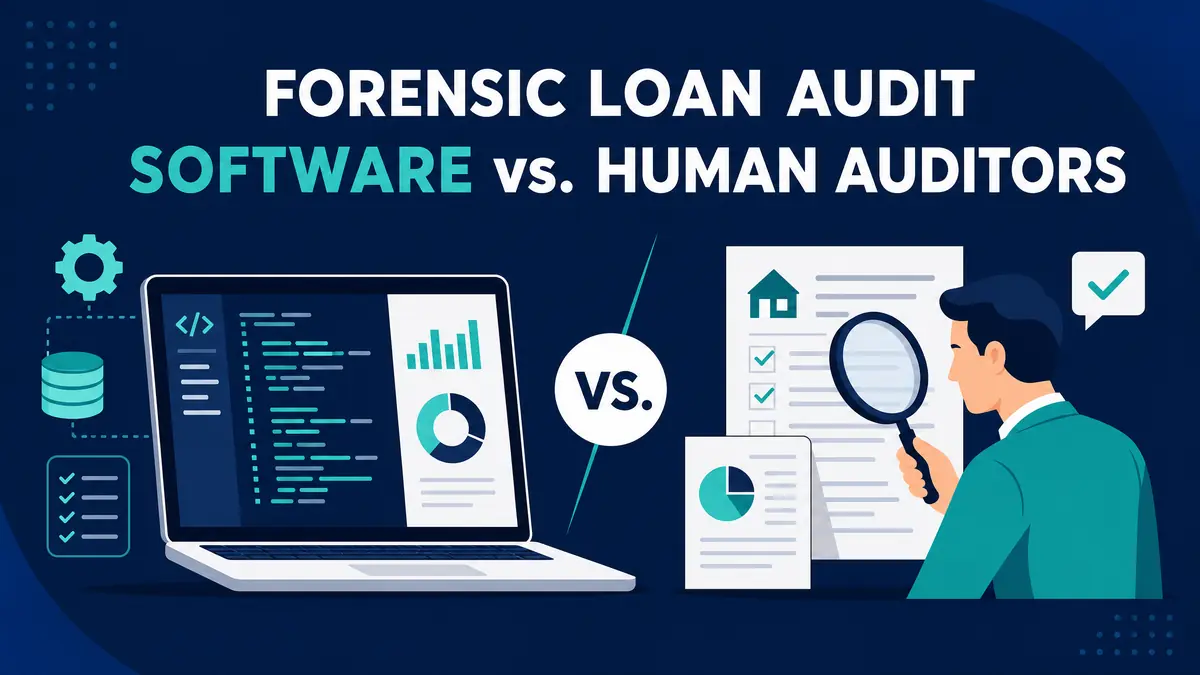
Technology has revolutionized the financial industry, and loan auditing is no exception. Today, forensic loan audit software can scan hundreds of pages of closing documents in seconds, flagging mathematical discrepancies and missing signatures. But while these tools are powerful, they cannot replace the critical thinking of a human auditor.
What Software Does Well
Audit software is excellent at finding quantitative errors. It can instantly recalculate an amortization schedule to verify that the Annual Percentage Rate, or APR, matches the stated interest rate and disclosed fees. It can cross-reference the fees listed on the Loan Estimate with those on the Closing Disclosure to ensure they do not exceed tolerance limits set by federal disclosure rules such as the Truth in Lending Act and the TILA-RESPA integrated disclosure requirements.
By automating calculations and pattern recognition, software allows auditors to work faster and eliminates the risk of human arithmetic mistakes. Common things software picks up quickly include:
- Incorrect math in payoff or payoff schedules.
- Duplicate charges or line items that appear more than once.
- Missing page scans or blank signature fields.
- Mismatches between documents, such as a different loan amount showing on the promissory note than on the closing statement.
The Human Element in Forensic Audits
However, a true forensic audit requires qualitative analysis that software simply cannot perform. A human auditor brings context, judgment, and legal awareness to the table. Software will flag a potential issue, but deciding whether that issue rises to a breach of contract, a compliance violation, or simple clerical error requires interpretation.
Examples Where Humans Add Value
- Pooling and Servicing Agreement review: A software tool can find that a loan was transferred, but it cannot read a PSA and decide whether the transfer followed the trust rules. A human auditor can trace the assignment chain and spot breaches in the transfer methodology that might affect ownership rights.
- Dual-tracking and communication context: Software can detect the dates of communications, but it cannot interpret tone or purpose. A human auditor can piece together timelines from emails, call logs, and borrower records to determine if a servicer was pursuing foreclosure while a loan modification request was still under consideration.
- Document authenticity and signature validity: Software can detect a missing signature field, but a human can seek alternate evidence such as an electronic signature audit trail, notary certificates, or attorney affidavits to confirm whether the document was properly executed.
Deeper Explanation of Key Concepts
APR and Amortization
APR is an annualized rate that reflects interest plus certain fees over the life of the loan. A miscalculated APR can indicate undisclosed fees or incorrect payment start dates. Forensic software recalculates amortization schedules by applying the interest rate and fees to each payment period. A human auditor verifies assumptions such as payment frequency, first payment date, and whether fees were financed into the loan principal. Small differences in assumptions can change APR outcomes, so human review is necessary to interpret what the software finds.
TILA-RESPA Tolerance Categories
Regulatory rules create tolerance bands for fees disclosed on the Loan Estimate versus the Closing Disclosure. Software can flag items outside tolerance, but the human auditor must determine if a corrected disclosure was issued, if a fee was legitimately allowed to change, or if there is an actionable violation. That determination often involves reviewing lender notes, invoices, and third-party provider records.
Step-by-Step Practical Advice for Combining Software and Human Review
Below is a practical workflow that shows the strengths of both software and people.
- 1. Gather complete document set: Obtain the note, deed of trust, closing disclosure, loan estimate, payment history, assignment and recording documents, servicing notes, and any correspondence.
- 2. Run software scan: Use forensic software to parse documents, recalculate numbers, and generate an initial list of flags and anomalies.
- 3. Triage flags: A human auditor reviews flagged items and separates clear errors from items that need contextual investigation.
- 4. Investigate context: For items that require judgment, the auditor pulls supporting evidence such as invoices, escrow analyses, PSA sections, or signature logs.
- 5. Legal and compliance review: Apply regulatory knowledge and contract law to determine whether findings represent violations or material errors.
- 6. Prepare narrative report: Compile findings into a coherent report that explains the issue, its impact, and recommended next steps. A human-written narrative is essential when presenting results to lenders, attorneys, or courts.
Practical Examples
Example 1: Software flags an APR discrepancy. The human auditor identifies that a financed lender fee was excluded from the disclosed finance charges, but the fee had been credited back on a correction. Only a human can determine whether the corrected disclosure was timely and whether the borrower suffered harm.
Example 2: Software finds a missing owner signature. The auditor requests the electronic signature audit trail and locates a timestamped acceptance by the borrower that satisfies execution requirements. The issue is closed without legal escalation.
Why SDAudit Combines Technology and Human Expertise
At SDAudit, we use advanced tools to assist our process, but every report is compiled and reviewed by an experienced human auditor. This approach gives you rapid, accurate detection of numeric errors plus careful interpretation of legal and contractual significance. Our reports are written for lenders, attorneys, and borrowers who need clear, defensible findings.
If you want a practical demonstration, explore our human-led audit process or reach out to our team. We offer a free consultation to review your situation, explain what our software finds, and show how our human auditors turn those findings into a clear path forward.
Contact SDAudit today for a free consultation and let us show you how smart software plus smart people produce trustworthy forensic loan audits you can use with confidence.